

By: Robert Holly, ASC News
The ambulatory surgery center (ASC) industry is entering 2026 with plenty of momentum, fueled by a shifting regulatory landscape plus rising demand from patients and payers alike.
But there are sizable hurdles ASC operators will need to clear as they move forward.
To help set the scene, Ambulatory Surgery Center News connected with 12 ASC leaders and market experts, asking them about the trends, challenges and opportunities likely to define 2026 most.
Those who participated in this Executive Forecast largely agreed on the big picture: More complex care will continue to move out of hospitals and into outpatient settings, driven by payer pressure, employer demand and regulatory changes that expand what can be done – and paid for – in ASCs. Spine, cardiovascular and orthopedic cases that once anchored inpatient revenue will increasingly be rerouted to lower-cost sites, reshaping health care dynamics in cities across the U.S.
But the growth won’t be straightforward. Several leaders warned that reimbursement risk will rise even as volume increases. Site-neutral payment proposals, tighter prior-authorization requirements and new administrative burdens loom as potential threats. At the same time, labor remains a structural constraint, pushing ASCs to rethink staffing models and invest in data, automation and more flexible workforce strategies.
Consolidation will be another defining theme of 2026, many industry insiders believe.
Taken together, the responses below – edited for style, length and clarity – paint a picture of what’s likely to be a critically important year for ASCs and their stakeholders.
DJ Hill, CEO, Compass Surgical Partners
What do you anticipate being the No. 1 factor shaping the ASC market in 2026, and why?
The biggest force shaping ambulatory surgical care in 2026 will be the continued shift of many higher-acuity case types into ASCs. With the recent publication of the final OPPS rule, CMS reimbursement policies are catching up to what surgeons have shown for years – that a broad range of spine, cardiovascular, musculoskeletal procedures can be delivered safely, with high quality, and at a lower cost for insurers and for patients.
That momentum is only accelerating, and ASCs that are ready to execute will lead the way.
What opportunity are you excited about in 2026, and why?
In 2026, I’m especially excited about the opportunity to expand the partnerships that have always been at the heart of Compass – and to forge new ones that let us serve more patients and providers.
From the beginning, my colleagues and I have believed that real progress in ambulatory surgical care comes from strong, aligned relationships with surgeons and health systems. What we’re seeing now is a growing demand for that kind of partnership-driven model: clinicians looking for teams who can help them develop and grow ASCs, and systems looking for ASC collaborators who can extend their reach.
Building on those connections – and multiplying them – is where we can have the greatest impact on health care in the year ahead.
Travis Messina, CEO, Regent Surgical
What do you anticipate being the No. 1 factor shaping the ASC market in 2026, and why?
Site neutrality, price transparency, and the elimination of the Inpatient Only (IPO) list are fundamentally reshaping the health care landscape and opening new pathways for ASCs. For many health systems, this shift is disruptive because it rewrites the playbook – moving procedures outside their traditional four walls requires new models and new thinking.
Yet the reality is that roughly 40% of ASC-eligible cases are still performed in hospitals, and those cases are steadily migrating. Success will depend on partnership. At Regent, we specialize in helping health systems not only operate ASCs but also build comprehensive strategies that deliver high-quality care at lower cost. That’s how we turn disruption into opportunity.
What opportunity are you excited about in 2026, and why?
In the coming year, Regent sees tremendous opportunity in pursuing markets and advancements that many peers avoid, recognizing that fundamental changes to the operating environment have rendered the traditional ASC growth playbook obsolete. By leaning into non-traditional ASC partnerships – such as our recent entry into the pediatric space and collaborations with leaders in academic medicine – we are embracing where the ASC sector is headed rather than where it has historically been, positioning ourselves to capture the true opportunities that lie ahead.
 Image of Patches West Ambulatory Surgery Center. | Image courtesy of Regent Surgical
Jessica M. Rodriguez, MBA, CASC, ASCA’s ASCAPAC Committee and Education and Programs Committee Member; Executive Director, OAM Surgery Center at MidTowne in Grand Rapids, Michigan
What do you anticipate being the No. 1 factor shaping the ASC market in 2026, and why?
One of the most significant forces in 2026 will be the potential reduction in insurance benefits if ACA subsidies expire. For ASCs – especially those with a high volume of elective procedures – any decrease in coverage or increase in patient cost-sharing could directly impact case volumes and care accessibility. Even minor benefit reductions can shift patient decision-making, delay necessary care, and stress ASC revenue models.
What opportunity are you excited about in 2026, and why?
After spending the better part of five years reacting to crisis after crisis – the COVID-19 pandemic, supply chain instability, staffing shortages, unprecedented wage escalation and anesthesia access challenges – I’m cautiously optimistic that 2026 may finally represent a period of stabilization. With a more predictable operating environment, ASCs can shift from defensive problem-solving to proactive growth: long-range strategic planning, facility expansion, service line diversification and clinical innovation. I’m excited for the opportunity to look forward again instead of constantly pivoting.
Waleed Nasr, Co-Founder and CEO, Medely
What do you anticipate being the No. 1 factor shaping the ASC market in 2026, and why?
A major factor shaping ASCs in 2026 will be their operational elasticity – the ability to flex staffing capacity up and down in response to demand. As demand for ASCs rises, and with labor representing about 50% of operating costs and 25% of ASCs citing staffing constraints as their top challenge, facilities can no longer depend on rigid, outdated staffing models.
The projected nursing shortage (over 200,000 by 2030) makes this even more critical. Patient volumes and surgical schedules fluctuate, but traditional full-time-heavy models don’t flex with those shifts. ASCs that build flexible workforce architecture – combining cross-trained internal teams, per diem pools and technology-enabled deployment – will have a competitive advantage over centers locked into approaches that can’t adapt to real-time demand.
What opportunity are you most excited about in 2026, and why?
To build on the previous question, I’m most excited about how new technology is finally making cross-training scalable. In ASCs, having nurses who can move fluidly between pre-op, circulating and PACU roles creates significant operational flexibility. Cross-training has always been a useful strategy across industries, but health care has struggled with manually tracking who has which competencies and deploying them effectively across an organization.
Now, we’re seeing unified workforce orchestration platforms use AI-driven skill mapping and automated credentialing to show which clinicians can work in which units/disciplines, update certifications in real time and match staff to shifting demand. When cross-training is paired with data-driven scheduling and flexible staffing pools, ASCs can adjust to surgical volume changes without compromising care quality.
Steve Hockert, Chief Development Officer, Solara Surgical Partners
What do you anticipate being the No. 1 factor shaping the ASC market in 2026, and why?
In 2026, the biggest driver will be the continued shift of high-acuity procedures into the ASC setting. Payers, employers and patients all want value, and ASCs are uniquely positioned to deliver that without sacrificing quality. We’re going to see more orthopedic, cardiovascular and spine migration than ever before. The groups that can combine clinical excellence with operational discipline will have a major advantage.
What opportunity are you excited about in 2026, and why?
I’m most excited about the growth of regional ASC networks that operate with true alignment between physicians and management partners. When you bring together great surgeons, strong data and well-run facilities, you can scale quality and efficiency without losing the culture that makes ASCs work.
Solara is leaning heavily into markets where we can replicate that model and build long-term partnerships that elevate care for the entire community.
Todd Currier, CASC, CPA, FACMPE, Treasurer of the ASCA Board; CEO/Administrator of Bend Surgery Center in Bend, Oregon
What do you anticipate being the No. 1 factor shaping the ASC market in 2026, and why?
Mergers and acquisitions will continue into the new year. Health systems and private equity are actively engaged in the industry, and I don’t see them slowing down as ASCs continue to be a strong asset in their health care portfolio.
What opportunity are you excited about in 2026, and why?
I am excited about the continued growth in business analytics within our industry. Implementing enhanced benchmarking platforms through ASCA and advancements in some of the top practice management systems that utilize our current data to enable us to ascertain areas of improvement.
Tim Fuchs, Chief Growth Officer, nimble solutions
What do you anticipate being the No. 1 factor shaping the ASC market in 2026, and why?
Payer-driven site-of-service optimization will be the defining force in 2026.
Commercial insurers are accelerating policies that push high-acuity procedures – orthopedics, spine, cardiovascular, GI – all into the lowest-cost setting possible. ASCs are the natural winner, but the shift is now being controlled by tightened prior auth, new risk-based contracts, more pre-service financial clearance requirements, and higher documentation burdens.
ASCs that can prove efficiency, clinical appropriateness and predictable outcomes will capture volume. Those that can’t meet the administrative/data driven lift will see case denials or leakage back to hospitals. RCM performance becomes a growth limiter or growth engine.
What opportunity are you excited about in 2026, and why?
The biggest opportunity in 2026 is the rapid evolution of managed care agreements – and the ability for ASCs to renegotiate smarter, more data-driven contracts. ASCs have the leverage and the market conditions to push for better implant carve-outs, case-rate structures that actually reflect current complexity, bundled reimbursement models tied to outcomes, more predictable prior-auth pathways, higher allowable rates for high-acuity migration, clearer definitions around medical necessity and documentation requirements, and more.
Payers are aggressively shifting complex procedures outpatient to cut costs, and that gives ASCs unprecedented negotiating leverage – but only if they come to the table with the right data.
 Tim Fuchs, chief growth officer of nimble solutions, speaks at the 2025 ASC News Investment & Operations Conference in Bonita Springs, Florida. | ASC News photo
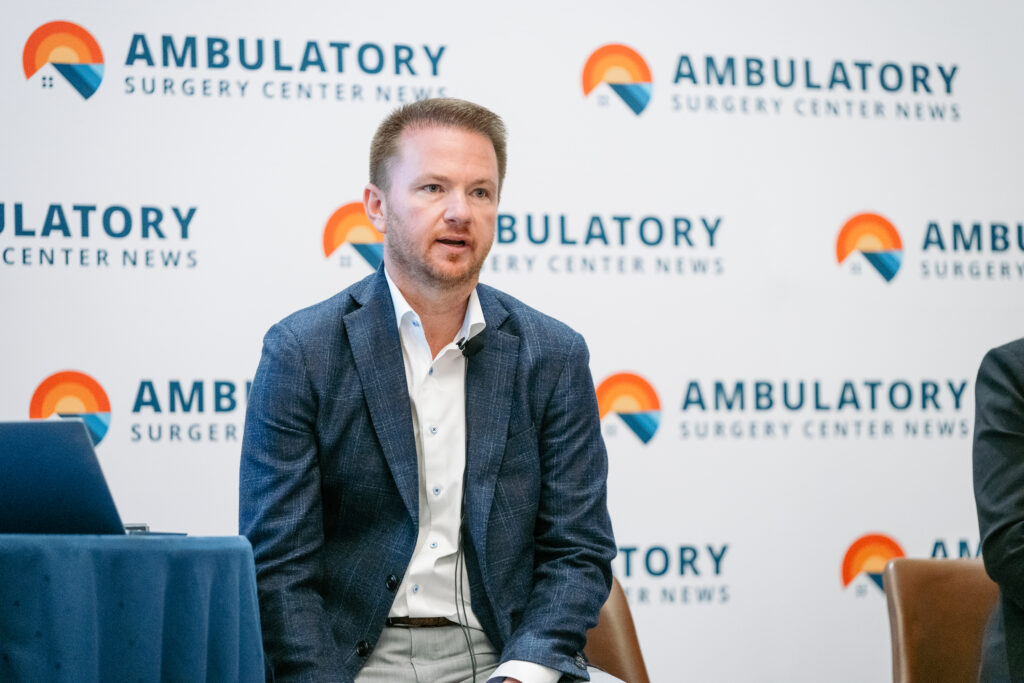 Tim Fuchs, chief growth officer of nimble solutions, speaks at the 2025 ASC News Investment & Operations Conference in Bonita Springs, Florida. | ASC News photo
Danilo D’Aprile, VP Business Development, Merritt Healthcare
What do you anticipate being the No. 1 factor shaping the ASC market in 2026, and why?
The No. 1 factor shaping 2026 will be the pressure between strong momentum toward ASC growth and the real possibility of site-neutral payment reform, which could actually create financial headwinds for ASCs.
On the positive side, CMS’s 2026 updates and the expanded ASC CPL continue to push more volume our way. Payers and surgeons are fully aligned around moving cases out of higher-cost settings, so the demand is there.
But the curveball could potentially be site-neutrality. A lot of people assume it will only impact hospitals, but if policymakers choose to “equalize” rates by pulling ASC reimbursement down, it could create a real issue, especially when anesthesia subsidies and staffing costs are rising faster than our rate updates.
So 2026 feels like an inflection point: ASC growth isn’t slowing, but the financial landscape around that growth is getting more complicated.
What opportunity are you excited about in 2026, and why?
The opportunity I’m most excited about is the continued expansion of what we can safely and efficiently do in the ASC setting. CMS is adding more complex procedures, surgeons are comfortable doing higher-acuity cases outpatient, and health systems are rethinking their outpatient strategy.
That creates a real opening for ASCs to build out cardiovascular, spine and robotics programs, and to form stronger partnerships with health systems that need a lower-cost, higher-efficiency setting for outpatient surgery.
If you have strong operations and good physician engagement, 2026 is a prime year to grow.
Danilo D’Aprile, president of the Arizona Ambulatory Surgery Center Association and Merritt Healthcare executive, speaks at the ASC News Investment & Operations conference.
 Danilo D’Aprile, president of the Arizona Ambulatory Surgery Center Association and Merritt Healthcare executive, speaks at the ASC News Investment & Operations conference.
Chris Schriever, Co-Founder and CEO, ASCdata
What do you anticipate being the No. 1 factor shaping the ASC market in 2026, and why?
The No. 1 factor shaping the ASC market in 2026 will be the acceleration of market consolidation. Driven by the confluence of rising labor and supply costs, stagnating reimbursement rates, and an increase in physician retirements, independent and smaller ASCs are under intense financial pressure.
Our data shows that most of these centers, typically operating with just one or two ORs across limited specialties, are struggling to manage mounting financial, administrative and compliance burdens on their own. This consolidation is the inevitable outcome. As centers seek partnerships with large, well-capitalized entities – whether corporate partners, private equity, or major health systems – it will fundamentally determine who controls the future of outpatient surgical care.
Crucially, this wave will also reshape the operations of suppliers, service providers, and RCM consultancies, as negotiations shift toward complex, system-wide contracts requiring sophisticated, data-driven analysis.
What opportunity are you excited about in 2026, and why?
I am most excited about the massive opportunity for operational innovation and efficiency gains driven by technology. As financial pressure forces more ASCs to pivot away from manual processes, this creates a critical opening for more advanced efficiency models, such as using AI to optimize scheduling and streamline complex workflows. I think embracing these efficiency models – which go beyond simple cost-cutting to maximize throughput and block time utilization – will help centers to protect their margins and secure their competitive position amidst rising costs.
Keith Smith, Medical Director, Surgery Center of Oklahoma
What do you anticipate being the No. 1 factor shaping the ASC market in 2026, and why?
The ASC market will continue to struggle with the urge to sell or merge with price-gouging hospital systems that continue to cash in on the payment discrepancy their lobbying secured from Medicare. Industry consolidation and the continued absorption of independent ASCs will remain the No.1 factor – one facilities should resist, as site neutral-payments are inevitable as the government’s plunge toward bankruptcy continues.
What opportunity are you excited about in 2026, and why?
The most exciting opportunity for the industry looking forward to 2026 will be the chance independent facilities have to accommodate price-sensitive buyers, whether individuals or institutional buyers. Independent ASCs (more nimble than their corporate or hospital-owned counterparts) that embrace price transparency have an exciting path ahead of them – one less dominated by the abusive carriers.
Lisa Austin, Senior Advisor, Avanza Strategies
What do you anticipate being the No. 1 factor shaping the ASC market in 2026, and why?
Increased regulatory controls, including prior authorization as well as WISeR (Wasteful and Inappropriate Service Reduction). The prior-authorization requirements are initially being rolled out in six states, but it is anticipated that more states will follow. The WISeR model will leverage artificial intelligence, along with human clinical review, to ensure appropriate Medicare payments for select services.
While the intent of both of these models is to improve care and decrease costs, there are other consequences to be considered. The patient may be delayed in getting necessary procedures in the “right” site of care, thus potentially causing conditions to worsen or getting care at a higher acuity facility, causing an increased financial burden. There may also be delays in payments to health care facilities, impacting overall operations.
What opportunity are you excited about in 2026, and why?
Continued migration of cases from the hospital to the ASC continues to bring new opportunities. This allows ASCs to provide care to patients that otherwise would have received care that may not have been ideal for the best outcomes and out-of-pocket fees. I am excited that the regulatory bodies continue to see the value that ASCs bring to the continuum of care.
Lisa Austin, senior advisor for Avanza Strategies, speaks at the ASC News Investment & Operations Conference.
 Lisa Austin, senior advisor for Avanza Strategies, speaks at the ASC News Investment & Operations Conference.
Scott D. Fraser, Founding Partner, Fraser Healthcare
What do you anticipate being the No. 1 factor shaping the ASC market in 2026, and why?
The primary factor will be increased demand for services driven by three key stakeholders:
– Payers will drive site-of-service shifts through new 2026 patient co-pay rates and expanded ASC coverage for higher-acuity procedures like Pulse Field Ablation (PFA).
– Informed Patients will increasingly choose ASC elective procedures over Hospital Outpatient Departments (HOPDs) due to better access, lower cost (co-pays/deductibles) and overall patient experience compared to hospital settings.
– Self-Insured employers will direct their covered lives to ASCs to limit their 2026 health care spend exposure. Facing unsustainable >10% increases in coverage costs, these employers are seeking direct contracting with ASCs in select markets for common procedures like joint replacements, colonoscopies and orthopedic repairs. Expect to see more of this in 2026.
What opportunity are you excited about in 2026, and why?
New CPT Codes, growth in cardiology and PFA coverage: I am excited about the 289 new ASC CPT codes and the very favorable PFA codes/coverage for ASCs.
Cardiology ASCs: We are witnessing a significant building boom in de novo cardiology ASCs, which is very reminiscent of the growth seen in GI in the 1990s–early 2000s, and orthopedics in the 2010s–2020s. Once cardiologists and electrophysiologists transition to the ASC setting for elective procedures, they are unlikely to return to the hospital. This shift will improve patient access and care, lower health care spending, and, importantly, boost physician morale. Physician-ASC ownership is a powerful market force, and happier doctors provide better care.
Higher Acuity Procedures: I am also excited about the enablement of higher-volume laparoscopic surgeries – such as gastric sleeves and cholecystectomies – by next-generation AI-powered surgical robots in ASCs.