
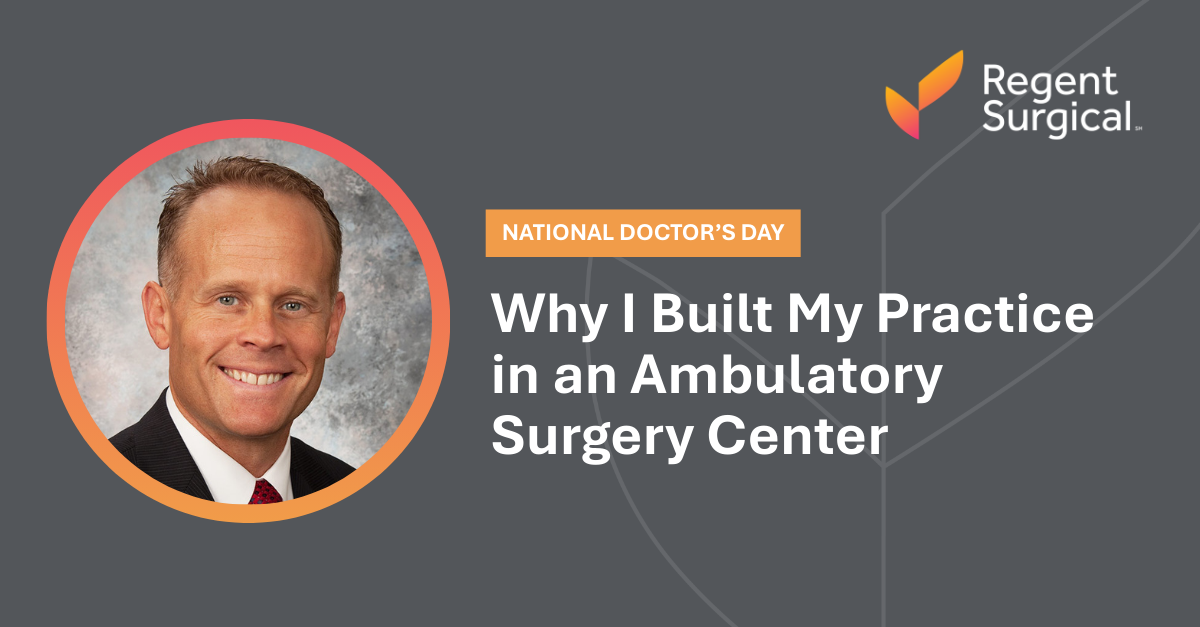
In honor of National Doctor’s Day, we are pleased to feature a column by Jim Ballard, MD. Dr. Ballard is an orthopedic surgeon and partner at Oregon Surgical Institute in Beaverton, Ore.
If you had told me 20 years ago that I’d be doing 10 total knees in a surgery center and heading home by mid-afternoon, I would have said that would never happen. In fact, I once declared that total knees would never belong in an ambulatory surgery center (ASC).
When I finished my orthopedic residency and fellowship in total joint replacement, surgery meant five days in the hospital and weeks in rehab. That was the model. No one was talking about doing hips and knees in a surgery center—it just wasn’t considered realistic.
Over time, though, things began to shift. I watched colleagues in sports medicine open their own centers, but I still couldn’t see a pathway for joint replacement.
My partner and I started with small questions in the hospital: Could we standardize protocols? Improve recovery? So, we did. And we got patients home in three days. Then closer to one. Eventually, we asked the bigger question: What if they went home the same day?
At the time, almost no one in the western United States was performing total joint replacements in an ambulatory setting.
Then I visited a surgeon in Ohio who was already doing it. I expected to see some secret technique. Instead, he operated the same way I did. There was no magic—just a different system built around efficiency and recovery.
I walked out of that case knowing we needed to move. After performing cases at a small local surgery center and searching for the right long-term solution, we partnered with Regent to open Oregon Surgical Institute (OSI) in 2018. We haven’t looked back.
Why the ASC Model Works
Once we began performing total joints in a surgery center, it became clear: Patients did well. They recovered at home. Complication and readmission rates were low. The overall experience was better.
The environment matters. An ASC is focused and purpose-built. Everyone aligns around the same goal. We encourage team members to work at the top of their license and to speak up when they see opportunities for improvement. That kind of responsiveness is difficult in a large hospital system.
It changed my experience as a surgeon, too. In the hospital, you prepare for a case, then wait. And wait again. In the surgery center, I stay in rhythm. My surgical pace hasn’t changed, but it’s more efficient. I’m less fatigued and more focused, which ultimately benefits patients.
Professional Autonomy and Quality of Life
The ASC model has been professionally invigorating. For the first time, I truly have a seat at the table. I help shape systems and build something that reflects how I believe medicine should be practiced.
It’s also improved my quality of life. Earlier in my career, I would finish six or eight hospital cases and get home at 8 p.m. Now I can do more cases and still be home in the afternoon. That matters for a surgeon’s well-being, family life, and the long-term sustainability of this work. I often wish I had made this move when my kids were younger; I could have spent a lot more time with them.
Surgeons were never promised balance, but the ASC model makes it more achievable.
The Financial Reality No One Talks About
There’s also a financial truth that most people don’t understand.
CMS and payer reimbursement for surgeons continue to decline. The surgery center is a separate business. Ownership creates a revenue stream that helps maintain independence.
The ASC model protects private practice orthopedics. It allows surgeons to remain independent and focused on patients—not just productivity metrics.
It’s also better for patients financially, with surgery centers offering the same high-quality care at a fraction of the out-of-pocket cost they’d face in a hospital.
Choosing the Right Partner
When we decided to build our own center, it took enormous effort—hundreds of hours of meetings, planning, and groundwork. We ultimately partnered with Regent, and to their credit, they understood something important: They didn’t interfere with what was working.
One of the fears surgeons have when working with a management partner is that they’ll impose hospital-style bureaucracy. That didn’t happen. Regent provided infrastructure and support, but they let us build the culture and run the clinical model the way we believed it should be run.
My Advice to Other Surgeons
If a surgeon is thinking about practicing in an ASC, my advice is simple: Do it now.
The road is paved. When we started, there was no road. Today, there are proven models, experienced partners, and clear data showing that patients do better in this setting.
This is the future of surgical care, and it’s the way to keep hip and knee replacements independent of major institutions. Now is the time to shift to an ASC.