
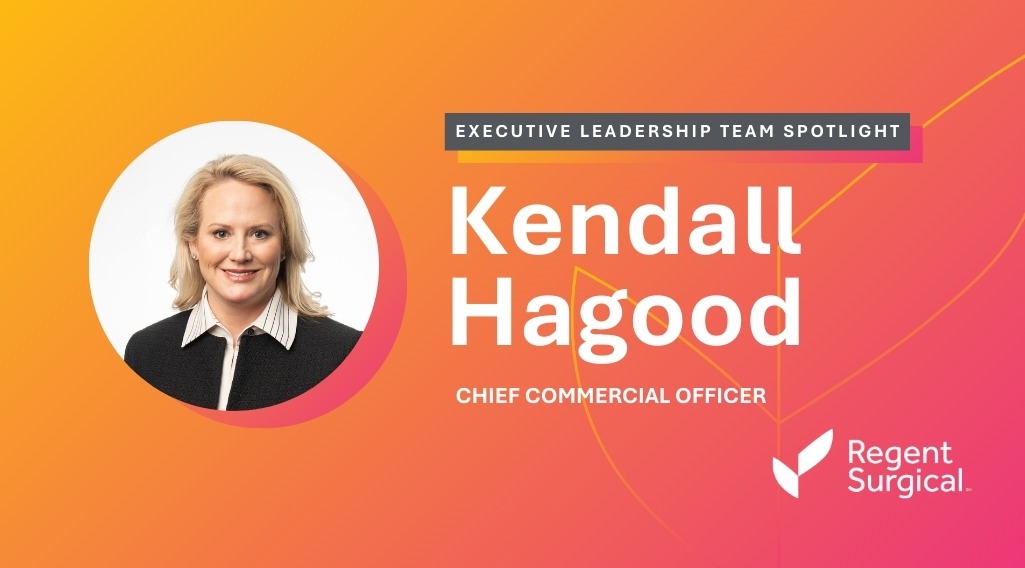
At Regent, our Executive Leadership Team plays a vital role in shaping our strategy, culture, and future. Through our ELT Spotlight series, we’re proud to introduce the leaders who guide our mission and drive operational excellence across the organization.
This month, we’re highlighting Kendall Hagood, Chief Commercial Officer. She is responsible for accelerating Regent’s growth and brand awareness, leading key initiatives in marketing, business development, customer success and innovation.
Tell us a little about your background and what brought you to Regent.
I’ve been fortunate to build a diverse career across many facets of the healthcare industry. I began my career as a dietitian, focused on employer wellness and service line development, and early on had the opportunity to help build a hospital from the ground up. That experience exposed me to a wide range of service lines – from urgent care and endocrinology to oncology and cardiac care – and gave me a strong foundation in how health systems really operate day to day.
When that health system was sold, I joined a venture capital firm, where I supported several portfolio companies in operational and technical functions, such as serving as director of engineering for a software development company, further expanding my experience in technology and operations.
That foundation led me to Contessa, a hospital-at-home and palliative care startup, where I joined as the sixth employee. I drew on my experience building a hospital to help scale the company, spanning marketing, partnership development, and the implementation of joint-venture models with health systems. After Contessa was acquired by Amedisys, I led integration and strategy efforts, ultimately guiding the company through its transaction with Optum.
What drew me to Regent is the thoughtful way the team works alongside health systems—helping them expand access, improve efficiency, and maintain high-quality care through well-run ambulatory surgery centers. I’ve enjoyed applying my background in partnerships, integration, and scaling organizations to fuel Regent’s growth. Today, I oversee health system partnerships, diligence, integration, de novo development, center applications, marketing, center applications, and project management.
How does your work impact patients, providers, or partners?
At Regent, we partner with health systems to thoughtfully develop and integrate ASC strategies that align with their broader organizational goals. That includes supporting employed physicians, expanding access, and enhancing the overall patient experience. At the same time, industry dynamics such as site neutrality, the elimination of the inpatient-only list, and greater price transparency are prompting health systems to reevaluate their ASC approach.
As health systems consider options such as extending surgical hours, adding new procedures, or employing additional physicians, we see ASCs as a powerful way to create new access points and reduce patient wait times. Our goal is to help health systems build ASC strategies that strengthen their clinical, operational, and financial performance—ultimately leading to a better patient experience.
How do you see Regent’s role evolving over the next five years?
Looking ahead, I see Regent continuing to focus on supporting health systems, while still playing a role with independent practices and ASCs. As a standalone organization with a diverse partner base, Regent is able to be more flexible, meet partners where they are, and be a thoughtful partner in developing their ASC strategy—whether that’s a health system or an independent physician. I think that independence and adaptability will continue to resonate with organizations looking for a partner that isn’t tied to a broader agenda.
What advice would you give to someone entering this field?
My advice is to say yes to opportunities early in your career and focus on learning from every experience. Even projects that are challenging or uncomfortable will make you stronger and help you learn how to adapt more quickly.
I never had a clear, linear career plan. I knew I enjoyed healthcare, solving problems, and creating new things—but I didn’t know what roles I would end up in or that titles like “chief commercial officer” even existed. By saying yes to new projects and reflecting on what I learned from each one, I was able to grow and apply those lessons in new ways.
Boundaries are important, but early on, being open to new opportunities and trusting yourself to figure things out can open doors you didn’t even know existed.
Who or what has influenced your leadership style the most?
The biggest influence on my leadership style has been learning to surround myself with people who think differently than I do. I tend to operate comfortably with ambiguity, move quickly, and make gut decisions—so I’m very intentional about building teams that balance that.
Recruiting teammates who are smarter than me and bring perspectives different from my own has been one of the most important leadership lessons I’ve learned. It also requires stepping back—especially when I’m inclined to move fast—to pause and truly listen before making a decision. That diversity of thought and approach helps us serve our patients and partners more thoughtfully and holistically.