
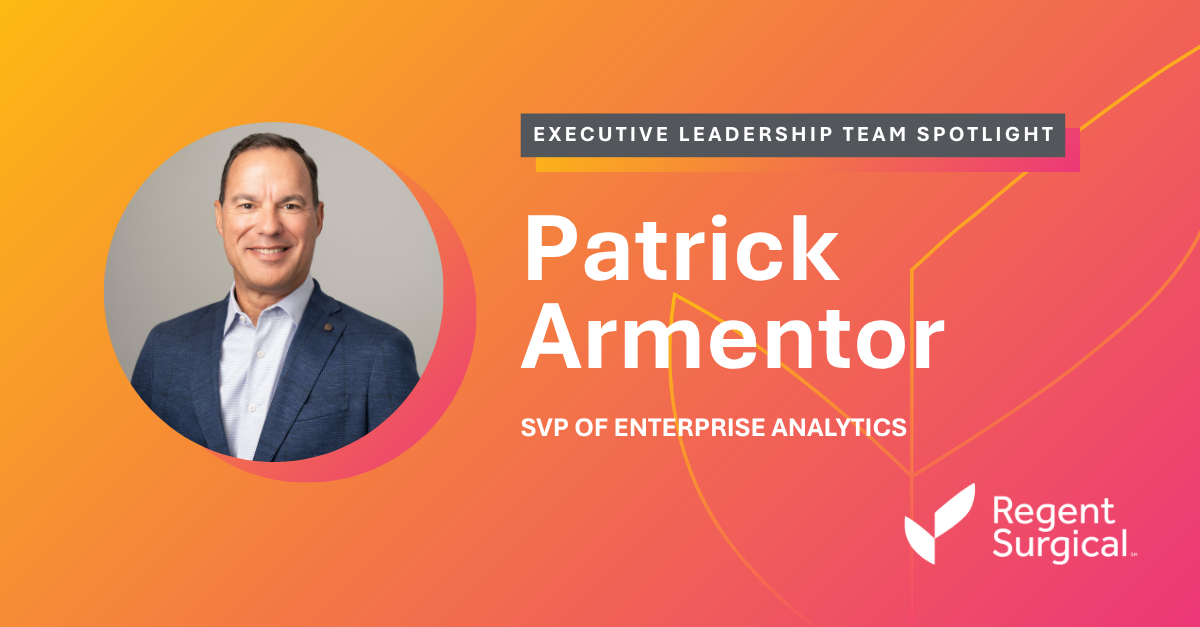
At Regent, our Executive Leadership Team plays a vital role in shaping our strategy, culture, and future. Through our ELT Spotlight series, we’re proud to introduce the leaders who guide our mission and drive operational excellence across the organization.
This month, we’re spotlighting Patrick Armentor, Senior Vice President of Enterprise Analytics. With more than 25 years of experience using data to improve healthcare delivery, Patrick leads the team responsible for transforming data into actionable insights across Regent’s network. His team’s work helps surgery centers optimize operations, enhance patient experience, and support informed decision-making that drives long-term success.
What do you enjoy most about working at Regent?
I’ve spent more than two decades putting data to work in healthcare — in hospitals, in value-based care, in home recovery — and what stands out at Regent is the people. They pair real curiosity with a willingness to try things, so good ideas actually move instead of stalling in a deck. I leave most days energized because the work is changing how our centers run, and the team makes it genuinely enjoyable to be part of.
How does your work impact patients, providers, and partners?
My team builds analytics that help center leaders see clearly and act quickly. When a center runs smoothly and safely, patients have a better experience, and physicians have more time to focus on patient care. For our health system partners, those same insights become a repeatable way to run surgery centers well, aligning workflows and technology so that strong performance holds over time rather than depending on any one person.
How do you see Regent’s role in the ASC industry evolving over the next five years?
Joint replacements, cardiac, and other high-acuity surgeries are no longer theoretical candidates for the ambulatory space. The migration to the outpatient setting is real and happening now. Over the next five years, I expect Regent to keep investing in the technology and systems that let our centers absorb that growth without compromising the experience patients and physicians count on. Our advantage is how we integrate with health systems, meeting partners where they are while helping them reach their own strategic goals.
How does data help Regent surgery centers perform better?
Data helps turn good intentions into a great plan. On the operational side, data helps centers and physicians optimize block time and schedules. In the supply chain, data keeps purchasing and pricing disciplined. On the growth side, data helps us identify physician recruiting targets and measure opportunities. Our analytics platform connects all of this for Regent’s center leaders and health system partners, so they spend less time hunting for answers and more time on improvement, expansion, and the patient experience.
How is Regent thinking about AI? Where do you see the biggest opportunities to use data more intelligently across the network?
I find the pace of AI genuinely exciting, but I care more about where it earns its place than about chasing every new tool. We are being deliberate, investing where AI advances quality and value for our centers, our physician partners, and the patients they serve.
The areas I see as most promising for Regent are agentic applications, administrative automation, and predictive intelligence. An AI-based agent integrated with the organization’s internal data can provide strategic advantages: expediting understanding complex topics and speeding up operational decisions. Administrative automation is a real opportunity to give care teams time back by removing the manual work that pulls them away from patients. And predictive insights are where AI has the potential to fundamentally change how our center leaders operate, shifting from reacting to problems after they surface to anticipating them before they do.
Across a network of more than 30 centers with deep health system partnerships, the compounding effect of getting those three areas right is significant. We are not chasing AI for its own sake. We are building a smarter network where better data means better decisions, and better decisions mean better outcomes for everyone in the room.