
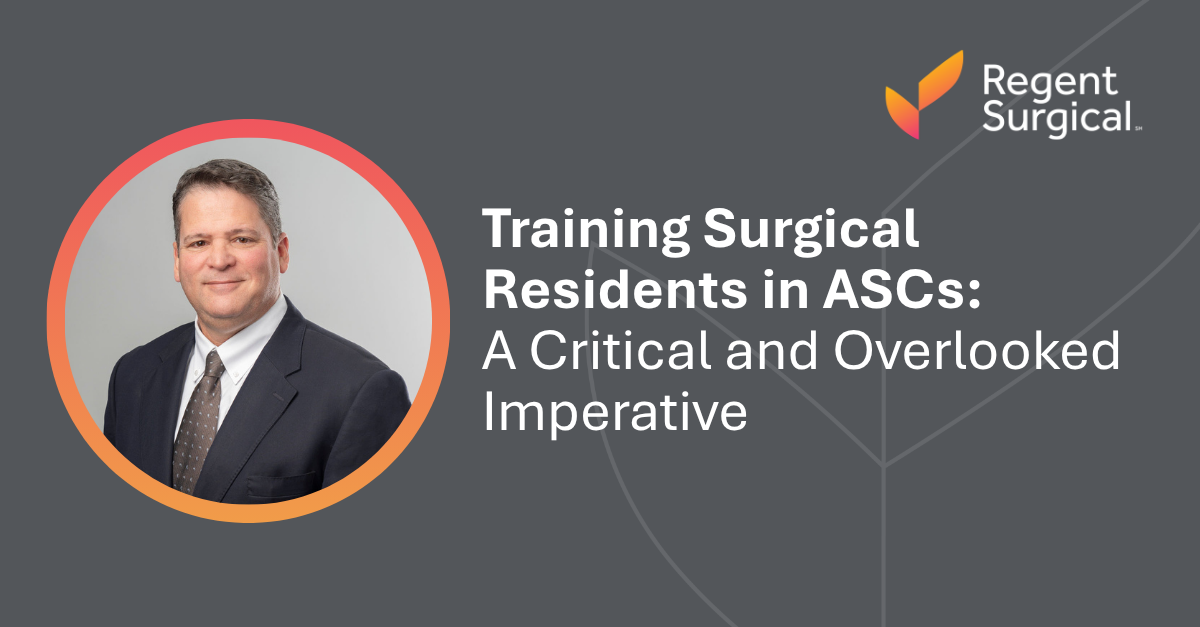
By Erik Kraemer, Chief Development Officer
The landscape of surgical care in the United States has shifted dramatically over the past two decades. Ambulatory Surgery Centers (ASCs) now account for a growing share of elective procedures, handling everything from routine colonoscopies and cataract extractions to complex orthopedic and minimally invasive abdominal surgeries. A growing number of outpatient surgeries in the U.S. are performed in ASCs, a trend that continues to accelerate as technology, reimbursement models, and patient preferences evolve.
Despite this shift in where care is delivered, most surgical residency programs continue to train residents almost exclusively in large academic medical centers and affiliated hospitals. This disconnect represents a meaningful gap in preparing the next generation of surgeons for the realities of modern practice.
Why Resident Training in ASCs Matters
ASCs were designed to deliver high-quality surgical care in a focused, efficient, and cost-effective environment. Free from much of the administrative complexity of hospitals, they are optimized for defined procedures, streamlined workflows, and carefully selected patient populations.
For graduating residents entering private practice, multispecialty groups, or academic systems with ASC partnerships, it’s essential to understand how these environments function.
Operational Competency
The ASC environment requires a different operational mindset than the hospital setting. Shorter case times, faster turnovers, and tighter coordination across teams demand adaptability and precision.
Exposure during training helps residents develop the practical awareness needed to navigate these environments effectively. They learn how scheduling, staffing, and equipment decisions directly impact outcomes, efficiency, and patient experience.
Efficiency and Time Management
One of the most common challenges for hospital-trained surgeons transitioning to ASCs is adjusting to expectations around efficiency.
In an ASC, efficiency is not a preference; it’s foundational to the model. Surgeons must plan cases carefully, communicate clearly with staff, and operate within defined timeframes.
Training in this setting builds discipline early. Residents learn to anticipate needs, standardize workflows, and collaborate proactively with surgical teams. These habits distinguish confident, practice-ready surgeons from those still adapting after training.
Patient Selection and Preoperative Judgment
ASCs depend on thoughtful patient selection. Not every surgical candidate is appropriate for an outpatient setting. Factors such as comorbidities, anesthesia risk, social support, and proximity to emergency services all play a role.
This type of decision-making is nuanced and often underemphasized in hospital-based training. Residents who rotate through ASCs gain a deeper understanding of ambulatory suitability and develop stronger clinical judgment around risk stratification.
Anesthesia Collaboration
The anesthesia model in ASCs often differs from that of large academic hospitals. Teams are typically leaner, and communication is more direct.
Residents benefit from closer collaboration with anesthesia providers, gaining a clearer understanding of sedation strategies, patient risk factors, and intraoperative decision-making. These interactions tend to be more conversational and educational than what is often possible in larger hospital systems.
Business and Practice Management Literacy
Modern surgical practice is closely tied to economics. ASCs operate with a strong focus on cost management, case efficiency, and quality outcomes.
Understanding how scheduling, supply chain decisions, reimbursement structures, and quality metrics intersect gives residents a broader view of surgical practice. This exposure is particularly valuable for those interested in ASC partnership or ownership.
While residency rightly prioritizes clinical training, early exposure to the business side of care delivery helps prepare surgeons for long-term success.
Quality, Safety, and Accreditation
ASCs operate under rigorous quality and safety standards, often accredited by organizations such as The Joint Commission or Accreditation Association for Ambulatory Health Care.
These frameworks include infection prevention protocols, emergency preparedness, fire safety standards, and adverse event reporting systems that differ in important ways from hospital-based models.
Training within these systems helps reduce the learning curve when residents transition into independent practice and assume responsibility for maintaining compliance and safety standards.
Addressing Barriers to ASC-Based Training
Despite the clear benefits, several structural barriers have historically limited resident training in ASCs.
Regulatory and funding constraints. Graduate Medical Education (GME) funding, largely administered through Centers for Medicare & Medicaid Services, is tied primarily to hospital-based training. This creates financial disincentives for shifting case volume to ASCs.
Operational pressures. ASCs are designed for efficiency. Introducing trainees can affect case flow, requiring careful planning to ensure educational value without compromising throughput.
Supervision models. Lean staffing structures can limit real-time teaching opportunities. Programs must intentionally partner with engaged faculty and build structured feedback into ASC rotations.
Credentialing and affiliation. Residents are not independently credentialed in ASCs. Clear agreements are required to define roles, supervision, and scope of practice.
While these challenges are real, they are not insurmountable. Programs that have invested in ASC rotations report high resident satisfaction and improved readiness for practice, particularly in outpatient settings.
Practical Steps for Integration
For program directors and department leaders, several strategies can help integrate ASC training effectively:
- Establish dedicated ASC rotation blocks, particularly for senior residents
- Partner with community-based or affiliated ASCs to expand exposure
- Incorporate ASC-specific didactics, including patient selection and operational workflows
- Provide shadowing opportunities with administrators, nurses, and OR staff
- Track performance using both traditional competency metrics and ASC-specific measures such as efficiency and communication
Preparing Surgeons for the Future
All signs point to continued growth in outpatient surgical care. According to Medicare Payment Advisory Commission, ASCs continue to gain ground in the U.S. health care system as procedure volume rises.
Surgeons who understand the ASC environment will be better positioned to succeed clinically, professionally, and financially.
Residency programs that remain exclusively hospital-based risk sending graduates into a practice landscape they have never fully experienced. Expanding training into ASCs is not simply an enhancement to surgical education. It is a necessary evolution.