
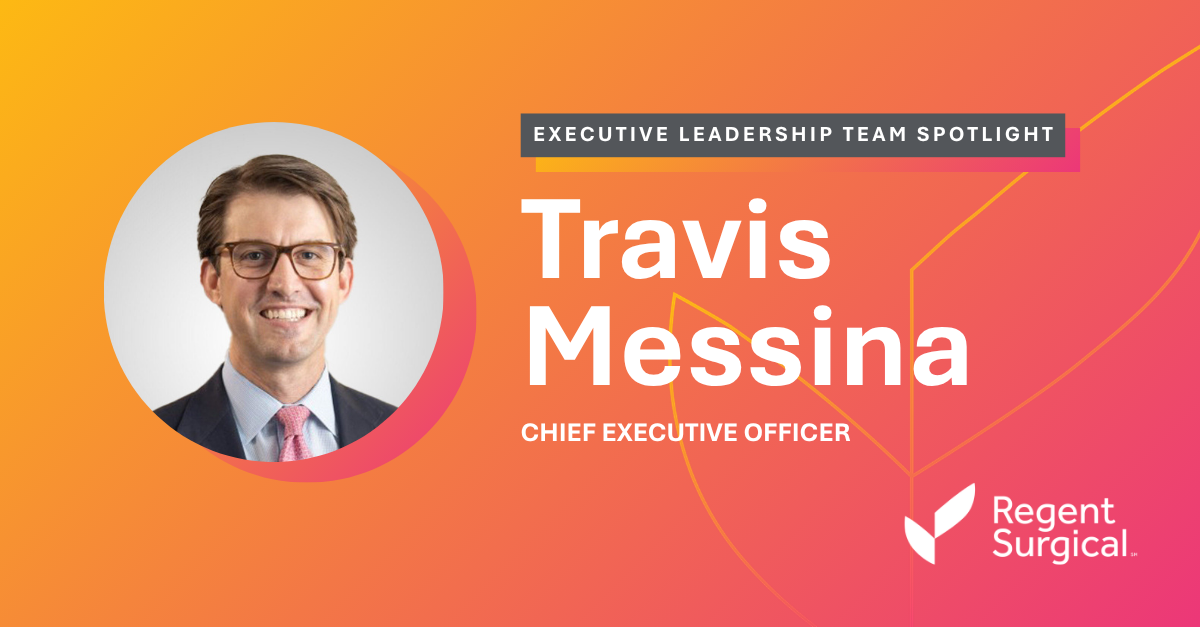
At Regent, our Executive Leadership Team plays a vital role in shaping our strategy, culture, and future. Through our ELT Spotlight series, we’re proud to introduce the leaders who guide our mission and drive operational excellence across the organization.
This month, we’re spotlighting Travis Messina, Chief Executive Officer. With more than two decades of experience building and scaling transformative healthcare businesses, Travis leads Regent’s network of ambulatory surgery centers. His background spans investment banking, venture capital, and operational leadership, with a particular focus on shifting care delivery away from traditional hospital settings. His vision centers on building a competitive advantage through clinical excellence and physician partnership while proving that growth doesn’t require compromise.
Tell us a little about your background and what brought you to Regent.
My path to Regent was by no means a straight line or well-planned. I like to say I “Forest Gumped” my way here. I actually wanted to be a musician, but ended up in investment banking (I know, logical path). As an investment banker, I worked on mergers and acquisitions covering healthcare services companies, including ASCs. I really wanted to be “on the corporate side” and ultimately went to do mergers and acquisitions for a large health system. Having that transactional experience led me to form a company that partnered with health systems to move the site of care for medically complex patients from the hospital to the home. With the combination of those experiences, when presented with the opportunity to join Regent, I was ready to take on the challenge.
What advice would you give to someone entering this field?
The field is crowded, and you have to think creatively about how you differentiate. To do that, don’t assume you know this business. ASCs are a different beast altogether; I learned that quickly when I joined Regent. My advice is to tour centers. Shadow the administrators to understand the economics and workflow. Scrub in on surgeries so you actually understand what the physicians need. Sit with surgeons and listen to what frustrates them in hospital systems. That hands-on learning is what lets you see where you can really differentiate. Roll up your sleeves, learn the business deeply, and then explore how to differentiate.
Who or what has influenced your leadership style the most?
This is a tough one. Picking an individual would be like asking me which of my children is my favorite. I am extremely lucky to have many mentors with tremendous experience leading some of the best healthcare services companies, and I have been influenced by my exposure to them. That said, the “what” is easier to identify. I truly try to embrace the learnings of Stoic philosophy. Centering my thoughts and actions on perception, action and will can help me strive to be the best version of myself in any situation. Although I’m Sicilian, sometimes it’s tough to manage my emotions!
What’s one trend in ambulatory surgery you’re watching closely?
The prevalence of robotics in ASCs. But it’s not just about having technology. It’s about what it unlocks strategically. Robotics expands the set of procedures we can perform at scale. Orthopedic complexity, multi-specialty cases, the kind of work that would otherwise migrate to hospital systems. That shifts our competitive position fundamentally.
We have robots in about a third of our centers today, and that number will increase meaningfully. We’re not passively watching this evolution happen. We’re actively building the infrastructure and partnerships to scale robotics across our network. We’re leading this shift, not reacting to it.
How do you see Regent’s role evolving over the next five years?
Regent’s mission is to redefine surgical care. That’s intentional. We set out on that mission because the industry has fundamentally changed since its inception nearly 50 years ago. Consolidation is squeezing independent centers, physician economics are shifting, payer dynamics are creating new demands, and technology is creating new possibilities. We must create a new model that combines the best of the old ways with new approaches to address those changes.
In five years, I see Regent as the go-to strategic partner for health systems building surgical strategies. We don’t manage ASCs independently. We manage operating rooms alongside our health system partners. That distinction matters. It means we’re helping health systems extend their surgical strategy, improve efficiency, and create long-term value together. That’s where the real redefinition happens.